
F&M Stories
Citizen Participation in Government Budgeting Flourishes in Democracies
The idea arose from a South American socialist government in the late 20th century — allow citizens to participate in the governmental budgeting process. Now spread worldwide, participatory budgeting has drawn the research interest of a Franklin & Marshall College professor.
"We talk about it as spreading in waves," said Associate Professor of Government Stephanie McNulty. "The first wave was in Latin America, the second wave is into more Central American, European, and some African countries, and the third wave is the U.S., Asia and the rest of Africa."
Most of the municipal, regional and state governments that provide participatory budgeting are in democracies. China and Russia also encourage citizen participation, which McNulty found "interesting, since they are not democracies." The Hewlett Foundation funds her and two researchers from other institutions.
"We don't know that much about its long-term impact yet," she said. "It's seen as a democratic policy tool in that citizens are given a voice in the budget process."
Whether governments listen to their citizens depends on the particular government. Participatory budgeting started under Brazil's Socialist Democracy Party in Porte Alegre, in 1989, but now takes place in thousands of jurisdictions around the world, McNulty said.
"An opposition party started it after a military regime," she said. "It was used as a successful example of civic engagement for many years. It's been really popular in Chicago, New York City and about 20 other U.S. cities."
For city council members, participatory budgeting permits spending a percentage of their discretionary funds on citizen-desired projects. "They are getting more people involved in the government process and deciding how to spend," she said. "If the public is deciding, it helps them make the tough choices together, it's a co-governance model."
McNulty and her research partners summarized the most up-to-date information for the Hewlett Foundation and Omidyar Network over the summer, information that was disseminated in three blogs issued recently:
Participatory Budgeting: Spreading Across the Globe
The Participatory (R)evolution: Four Major PB Transformations Over Time
Participatory Budgeting: Does Evidence Match Enthusiasm?
"Most of the research suggests that if the government is really open to citizen participation, and citizen groups are strong enough to really participate in a robust way, it tends to have some fantastic outcomes," she said.
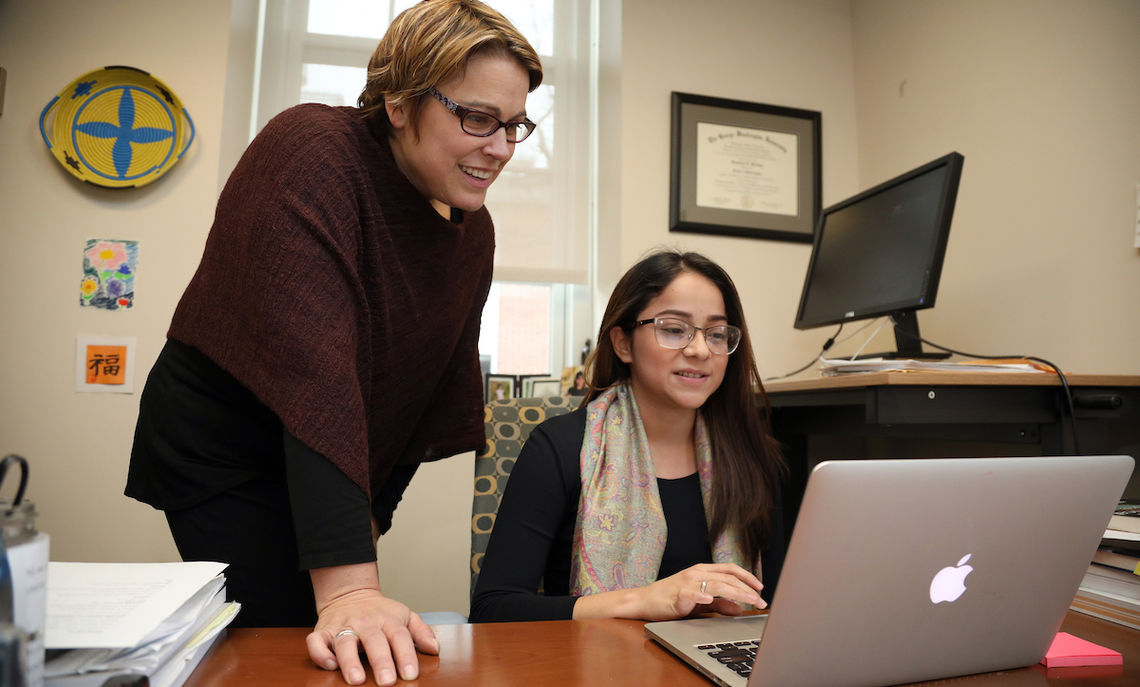
Earlier this year, McNulty returned to Lima, Peru, where she has done research for decades, with F&M Hackman scholar Amy Largacha Cedeno, a junior economics and government major. For one month, they observed and recorded participatory budget meetings.
"We observed how many men and women attended and who was speaking," McNulty said. "We got down to the nitty gritty of who actually has power in these meetings through discourse — who is speaking and who is presenting."
They found more women attended, but most of them did not speak, suggesting the municipal authorities exercise paternalism over citizens, she said. "The municipal officials are dominating the meeting, so they are not exactly participatory."
After each meeting, McNulty talked to neighborhood groups to get their thoughts.
"They usually ended up thinking that the mayor was corrupt," she said. "The idea is to get more people involved in government so they start to learn more about government and also to make public spending more transparent, so they can start to oversee public works and end corruption. That is not happening in most Peruvian cities."
Related Articles
September 30, 2026
Patricia E. Harris '77 to Receive Inaugural Benjamin Franklin Distinguished Innovator Award
This fall, Franklin & Marshall College will debut a new honor and celebrate the career and leadership of one of its most accomplished graduates: Patricia E. Harris '77, Bloomberg Philanthropies CEO, former first deputy mayor of New York City, and Trustee Emerita.
September 24, 2026
F&M Poll: Economic Concerns Shape Voter Attitudes in Pa. 7th and 10th Districts
The preferences of registered voters living in Pennsylvania’s 7th and 10th Congressional Districts show patterns that are similar to state and national data that favor Democratic candidates, according to the latest Franklin & Marshall College Poll.
September 18, 2026
Lessons in Leadership: Entrepreneur Lynn Greenberg ’14
Lynn Greenberg ’14, founder and CEO of Pivt Enterprise, recently returned to F&M to share wisdom and kick off a lecture series at F&M presented by The Mehlman Leadership & Performance Institute. “F&M is the perfect place to lead you into entrepreneurship,” she said.