
F&M Stories
Mentors Benefit as Much as Mentees
Franklin & Marshall's Jennifer Morford, professor of chemistry and 2021 recipient of the Christian R. and Mary F. Lindback Foundation Award for Distinguished Teaching, recalled an impromptu mentoring moment that she had in high school.
In the chemistry laboratory just before class started, she and a friend were lamenting the school's beloved band director leaving his position, she told the Nov. 11 virtual Common Hour audience. Her friend suggested this was probably the best time to leave band for other school activities.
At that moment, her chemistry teacher, who was quietly listening to them, said, "Sometimes, moments of change with the associated anxiety are times to leave, but sometimes, they present us with an opportunity to engage in ways that might result in greater investment and with surprising outcomes."
"I have reflected on that conversation, which happened over 30 years ago, many times in my life, and use that reflection to help me make decisions in terms of situations," Morford said.
"Thinking about Mentorship: We Know It's important but How Does It Work?" was the title of her lecture about the role of mentor and mentee.
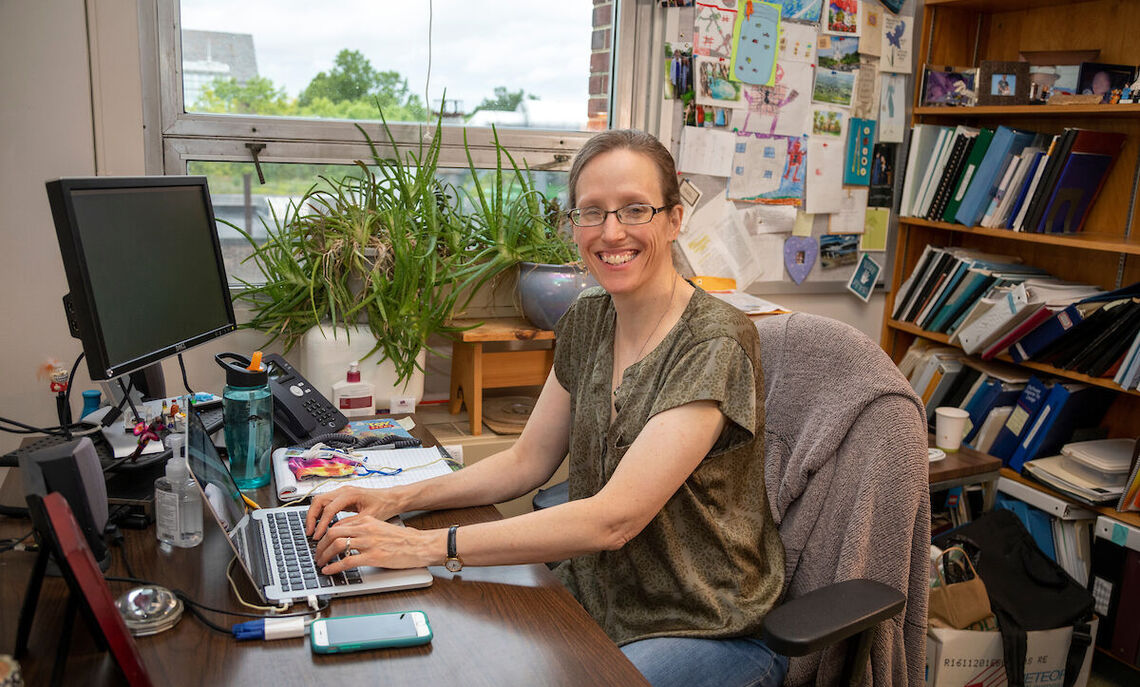
A teacher, scholar and mentor, Morford earned a bachelor's degree at Boston College and a doctorate at the University of Washington. "[She] balances intellectual challenges with warmth," said Justin Hopkins, assistant director of the Writing Center, in introducing her.
"Professor Morford's intense interest in support for and willingness to adapt to students' needs is seen in her students' successful careers and well-being," Hopkins said. "She's found those experiences to be one of the best parts of her job, and they've inspired her to learn more about mentorship."
The professor said her varied experiences as a mentor to a diverse group of students (including the Miami Posse Scholars, whom she mentored on research), "have inspired me to learn more about mentorship and how to be a more effective mentor."
A first-generation college student, Morford thanked colleagues in the departments of chemistry, history, geosciences and classics for mentoring her. "All of these relationships and experiences have impacted how I teach, how I do my research, how I engage with college service, and how I work with my students."
Morford said the "profound support and help" they provided during important transitions in her life "have subtly and substantially influenced my trajectory. Yes, as a professional having mentors has continued to be important... This is my effort than to help you explicitly acknowledge and recognize all the different aspects of mentorship."
She shared her experience, as well as her knowledge from studies and conferences on mentoring, and asked the audience to take a moment to "think about a time in your life when you shared your knowledge, your skills, your time, your insight to help someone else, and how that felt."
"You are reflecting on spaces where you were probably the mentee and spaces where you were probably the mentor," Morford said. "This exercise highlights how we play both roles throughout our lives. And if these memories were positive and meaningful to you, then you probably already know something about mentorship and how important it can be for you and for others."
"Mentor" comes from a character in Homer's "Odyssey," the book was recommended to her by a colleague in the Department of Classics. When King Odysseus went to fight the Trojan wars, he asked a trusted friend, Mentor, to advise and teach his son in his absence.
"In this way, the first mentor was both a guide and an educator," Morford said.
She cited a recent report from the National Academy of Sciences that defined mentorship as a professional working alliance in which individuals work together and over time mutually support their personal and professional growth, development and success as partners.
"I really like this definition because I like the term 'working alliance,' which is meant to emphasize an act of collaboration between mentor and mentee," Morford said.
The professor acknowledged the difficulty sometimes in finding a mentor "that meets all of your interests and all of your needs," both of which "change and evolve as you move along your path."
Morford advised students to "be open to the frequent opportunities you have to connect with peers, faculty, staff, and others on and off campus to create a constellation of mentors. This network of overlapping relationships is more likely to meet your evolving needs while providing you a diverse community."
Related Articles
April 30, 2026
First-Year Students Honored for Excellence in Writing
Three Franklin & Marshall College first-year students were recently recognized for their exemplary writing across a wide range of subjects they discovered through their Connections courses, which are explicitly designed to help new students explore and answer complex questions related to real-world issues.
April 27, 2026
F&M Launches Partnership with Carnegie Mellon University’s Heinz College for Scholarship Program in Policy, Tech, and Arts Graduate Programs
Franklin & Marshall College and Carnegie Mellon University’s Heinz College of Information Systems and Public Policy announced a new partnership to provide pathways for F&M students into high-demand graduate programs in public policy, technology, and the arts, offering a meaningful tuition support and access to industries including government, technology, cybersecurity, and entertainment.
April 16, 2026
Collaborative Student-Led Podcast Explores Impact of AI
Students at Franklin & Marshall are bringing a liberal arts perspective to discussions about artificial intelligence — and are doing so through an innovative media project. “Unmasking the Machine: A Sociological Look at AI” is a podcast produced as part of the course "Sociology of AI" that applies sociological concepts from the course to current headlines about artificial intelligence.