
F&M Stories
Research Fair: Student Samples Sounds With Synthesizers, Space
With electronic keyboards, synthesizers and computer software programs, Amanda Peterson explores electronic music and natural sounds to create her composing project.
"It's the intersection of the natural sounds you might hear with something that's not acoustic, but electronic," the Franklin & Marshall College Hackman Scholar said.
In her self-designed research encouraged by Matthew Butterfield, professor of music and Roschel College House don, Peterson used the research funds she received to purchase the electronic equipment and software she needed to compose and record her music.
"I wanted exposure to the technology and figuring out what kind of sounds I like and how to use those sounds," said Peterson, who plays the flute and piano.
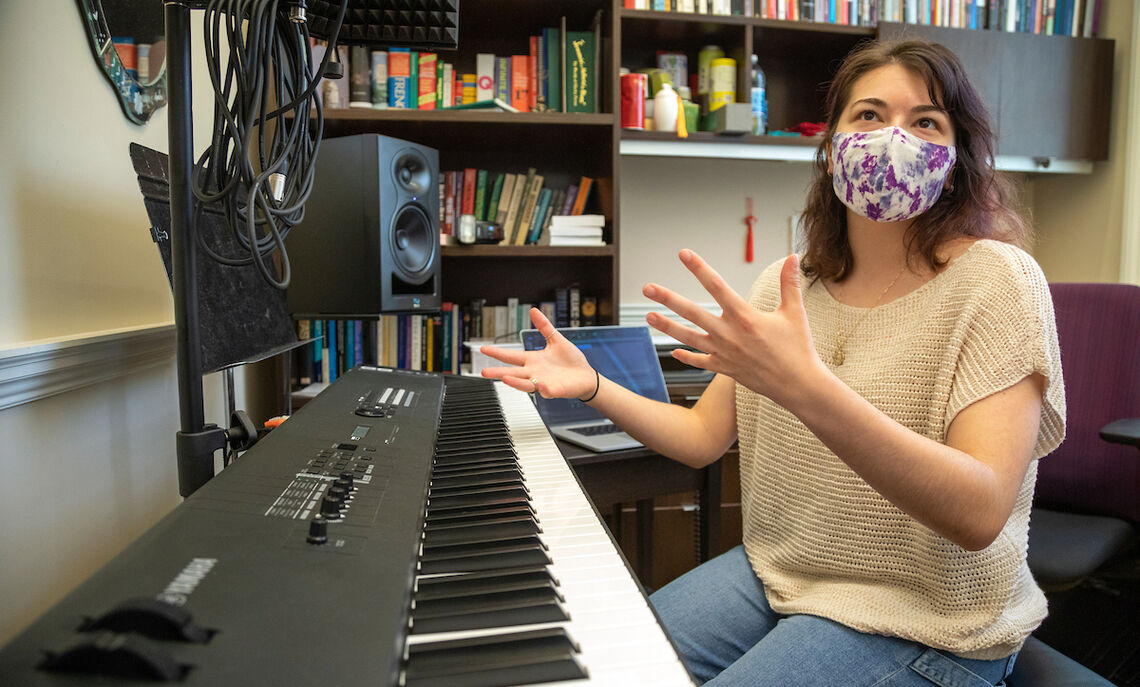
As she sat at a Yamaha keyboard console in Butterfield's College House office, the senior English and music double major explained the purpose of her work.
"I was really interested in electronic music, basically anything that uses synthesizers, computers, things that could be made without an acoustic instrument," Peterson said. "I wanted to see how they play with space and time because synthesizers aren't real sounds."
Synthesizers imitate musical instruments, but can also be programmed to create sounds heard in nature and the real word, Butterfield said.
"With sound production technology, you can take sounds from the environment and transform them in some way—compressing them, filtering them—to defamiliarize them," Butterfield said. "In doing that, you offer a different perspective on those sounds and the spaces they're typically heard in."
To see how she could create different spaces, Peterson used samples of sounds from everyday life to see the interaction with electronic music.
"So I put together the sound of people walking with the synthesizer sounds," she said. "What kind of feeling or mood does that create? Is that something reminiscent of real life or does it take us out of reality?"
Butterfield explained that her composition is more layered then just those sound sources. "That's part of it, but also getting some drum loops and other kinds of sounds in there to enhance the texture of the environment. It's some really cool stuff that she's come up with," he said.
Peterson has several compositions that she continues to work on for honors consideration in the Department of Music and plans to become a music history professor. She was enlightened by the research and work composing and recording.
"It really changed how I listen to music as a whole because once you learn production software and the different effects and filters, you start to hear that in regular music whether it be electronic or pop music on the radio," she said. "It changes your understanding and appreciation of how much work actually goes into producing songs."
Related Articles
September 2, 2026
‘I Find It Important and Necessary’: Uncovering Lancaster's Hidden History
For Frances Taylor ’27, the Lancaster Vice project checked all the right boxes: collaborating with a faculty mentor, exploring how their two majors converge in the real world, and unearthing stories the city had forgotten. “I enjoy learning about hidden history that popular culture often overlooks,” Taylor said.
August 26, 2026
Reckoning With Lancaster: Exploring Refuge, Migration, and Belonging
What does it mean for a city to be “welcoming”? Lancaster has embraced that identity, but its history tells a more complicated story. F&M students spent eight weeks exploring the people, places, and experiences that illuminate Lancaster’s evolving relationship with immigrants and migration.
July 20, 2026
F&M Experts Weigh in on Wildfire Air Quality
As Canadian wildfire haze blanketed the mid-Atlantic last week, local news sources turned to experts at F&M for air quality and public health insights. Professor of Geosciences Robert Walter '75 has been monitoring Lancaster’s air-quality index via a sampler machine atop of the Alumni Sports & Fitness Center.